
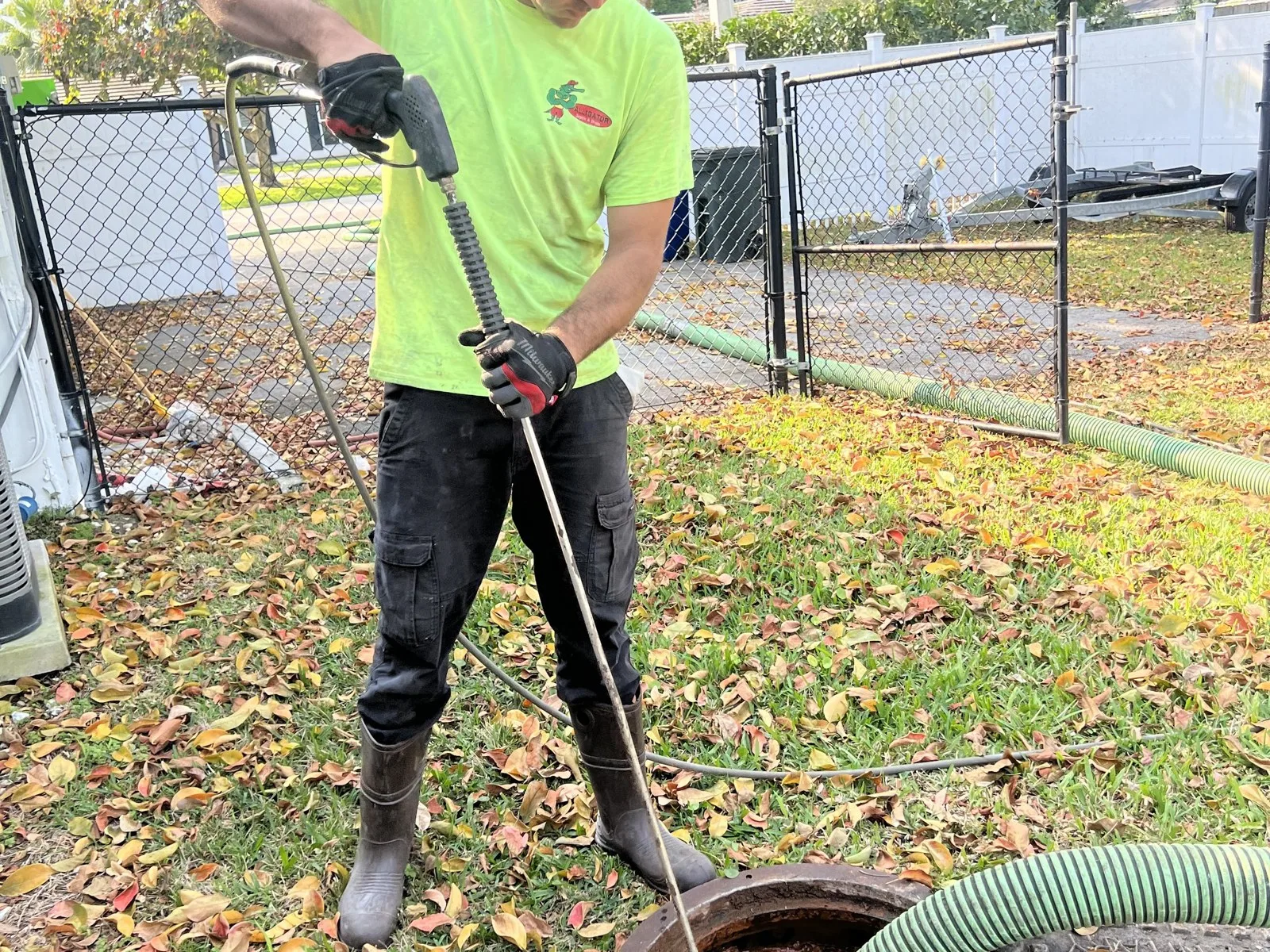
What are the signs your septic tank is full?
The warning signs the EPA lists are slow-draining tubs and sinks, gurgling in the plumbing, sewage odors around the tank or drain field, standing water or damp spots over the system, bright green spongy grass in the yard, and wastewater backing up into the house. Any one of them says the system is struggling. Two or more say to stop and deal with it now.
If it has already reached the backing-up stage, our emergency septic pumping runs around the clock across Broward, Palm Beach and Miami-Dade. For everything short of that, here is how to read what your system is telling you.
The warning signs, from quiet to loud
| Sign | What it usually points to | How urgent |
|---|---|---|
| One slow fixture | A clog in that fixture’s line | Routine |
| Whole house draining slowly | Tank overdue or field struggling | Call this week |
| Gurgling toilets and drains | Air trapped by a blockage or full tank | Call this week |
| Sewage odor in the yard | Tank or drain field venting | Call this week |
| Bright green, spongy grass | Drain field leaking upward | Call now |
| Wet ground over the system | Field not absorbing, or a saturated yard | Call now |
| Sewage backing up indoors | System has no capacity left | Emergency, any hour |
Slow drains through the whole house. One slow sink is that sink’s problem. Every fixture draining slowly, with the lowest ones worst, is a system problem.
Gurgling. Air moving through water where it should not be. Gurgling toilets and drains are often the first sign the tank or field is not passing water.
Odors. Sewage smell around the yard, the tank lids or the drain field. The EPA notes a foul odor is not always the first sign, so its absence proves nothing.
A too-green stripe of lawn. Bright, spongy grass over the drain field in dry weather means the field is feeding the lawn, which means it is not absorbing the way it should.
Wet ground. Standing water or muddy soil over the tank or field on a dry day. In South Florida, sort this against the season: a yard that squelches everywhere in September may be the water table rather than the septic system.
Backups. Wastewater at the lowest drains, showers and floor drains first. This is the loud end, and it is a health issue as well as a plumbing one.
Full tank, clogged line, or failed drain field?
“Full” needs unpacking, because a healthy septic tank is always full of liquid. Every gallon in displaces a gallon out to the drain field. The tank needs pumping when sludge and scum have taken over too much of that volume; extension services put the line at roughly a quarter to a third of the tank.
The parts tell you which problem you have. A blocked inlet pipe stops the house drains but leaves the yard dry. A clogged outlet or filter backs sewage up near the tank. A failed drain field shows up as the wet, smelly yard and a tank whose liquid sits above the outlet because the water has nowhere to go. A stubborn clog in the line is its own fix; our hydro jetting clears grease and roots a snake cannot. Pumping helps a full tank the same day, but extension services are blunt that pumping cannot revive a completely clogged field. Catching it at the slow-drain stage is what keeps you on the cheap side of that line.
What to do the moment sewage backs up
First, stop adding water. Florida health officials say to conserve hard: minimize the washing machine and flush only when necessary. Every gallon you hold back is a gallon that does not come up the shower drain.
Keep people and pets away from the sewage, indoors and out. Household wastewater carries bacteria and viruses; the EPA’s list of what it can cause runs from ear infections to hepatitis. Cleanup means rubber boots, rubber gloves, hot-wash for the clothes you wore, and disinfecting hard floors; anything soft that soaked, like carpet, is usually a loss.
Never open the tank yourself, and never lean into or enter one. Septic tanks hold gases that can cause immediate unconsciousness; Penn State’s guidance is two words long: never enter.
Stay off the drain field with vehicles. Saturated soil compacts easily, and a compacted field is a shorter-lived field.
Then call a pumper. Say what is backing up, when it started, and whether the yard is wet. That is enough for us to tell you what the visit likely involves and to give you a real arrival window, any hour.
What not to pour in
Skip the additives and the chemical drain openers. The EPA does not recommend additives, and a Washington State University review found no difference in sludge levels between tanks that used bacterial additives and tanks that did not. The harsher products are worse than useless: strong acids and alkalis can sterilize the tank, push raw sewage to the field, and corrode concrete. If a bottle promises you will never need pumping again, what it usually does is move the solids to the most expensive part of your system.
The South Florida wrinkle: a flooded yard changes the rules
After a tropical storm or a heavy wet-season week, a struggling septic system may just be a drowned one. Florida Department of Health guidance is explicit: do not have the tank pumped while the ground is saturated, because a tank pumped dry in waterlogged soil can collapse or float, and if the real problem is the high water table, pumping does not help. Florida’s design rules want 24 inches of dry soil under a drain field, and in a soggy year low-lying lots lose that margin.
So when the yard is flooded: cut water use, wait for the ground to drain, then pump and inspect. When the drains are failing and the yard is dry, that is the tank talking. Our guide to how often to pump a septic tank in Florida keeps you ahead of the schedule, and the cost guide shows what waiting tends to cost.
When in doubt, get eyes on the tank
Every sign on this page gets its answer with the lid open: where the liquid sits, how thick the sludge is, what shape the baffles are in. That takes minutes for a crew that does it every day. Call (954) 350-2046, any hour, and tell us what you are seeing. We will tell you honestly whether it is a schedule-it visit or a right-now visit.