Grease trap vs grease interceptor in Florida: what is the difference?
Florida’s grease waste law gives both words one definition. The small indoor unit usually called a grease trap is a hydromechanical interceptor, rated by flow. Florida’s plumbing code sizes the big outdoor tank, a gravity interceptor, to hold 30 minutes of peak flow. Miami-Dade’s FOG program sets cleaning every 30 days for the first and 60 for the second.
Both types hold back fats, oils and grease so clear water can move on. Our grease trap and grease interceptor cleaning covers both, scheduled or on call, across Broward, Palm Beach and Miami-Dade.
What does Florida law call a grease trap?
Florida’s grease waste statute, s. 403.0741, defines ‘grease interceptor or grease trap’ as one thing. It is a receptacle that wastewater with fats, oils or grease flows through before it enters a drainage system. It traps the grease and lets clear water escape.
Florida’s plumbing code sorts these units by how they work. Its Chapter 10, Traps, Interceptors and Separators, sets separate rules for hydromechanical and gravity grease interceptors. Its definitions say a gravity unit holds the water at least 30 minutes, and gravity does the separating. A hydromechanical unit separates grease with air, buoyancy and baffles as the water flows through.
Miami-Dade draws one more line, by where the device connects. In its FOG Control Program, a grease trap sits between a fixture, such as a three-compartment sink, and the drain. A grease interceptor connects to the building’s grease waste drain.
What is a hydromechanical grease interceptor?
It is the compact unit that usually sits indoors, close to the sinks it serves. Miami-Dade’s FOG guidance manual says they must be third-party certified. They are rated by flow, commonly up to 100 gallons per minute. Grease Trap Florida’s 2026 guide says under-sink traps typically hold 20 to 100 gallons.
Florida’s plumbing code rates them two ways: flow in gallons per minute and the pounds of grease they must hold. A unit rated at 50 gallons per minute must hold 100 pounds of grease.
The name changed in Miami-Dade’s own rules. Its proposed ordinance of June 2015 set monthly cleaning for ‘manual grease traps.’ The approved program sets 30 days for hydromechanical interceptors, manual and automatic.
What is a gravity grease interceptor?
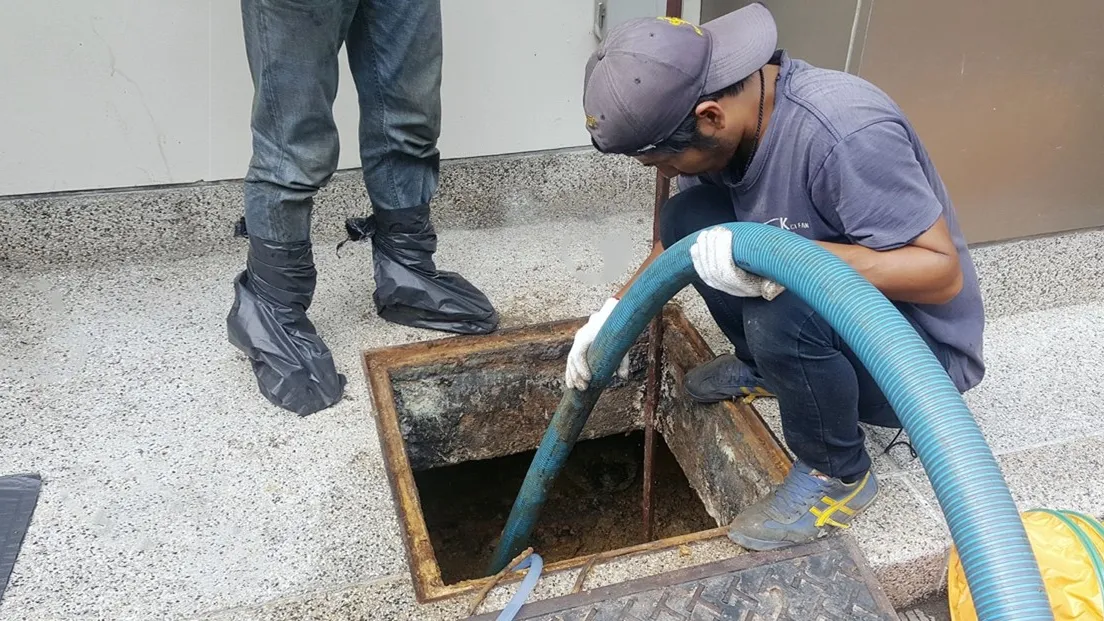
It is the big tank outside the building, usually underground. Miami-Dade’s FOG guidance manual says gravity systems must be located outdoors and are most commonly concrete. Grease Trap Florida describes concrete or fiberglass vaults in the parking lot or beside the building. They run 500 to 2,500 gallons or more.
Florida’s plumbing code sets a gravity unit’s capacity at its peak drain flow, in gallons per minute, times 30 minutes. At a peak flow of 25 gallons a minute, that works out to 750 gallons. In Miami-Dade, the FOG guidance manual puts the minimum for any gravity interceptor at 750 gallons, citing a state rule.
Kitchens on septic follow their own section of the code. Only kitchen wastewater passes through the interceptor, and then it flows into the first compartment of the septic tank. The interceptor must be watertight and built to carry loads such as vehicle traffic. Keep the tank on its own schedule too, with regular septic tank pumping.
How do a grease trap and a grease interceptor compare?
The small unit costs less per visit but needs more visits. The big one costs more per pump-out and goes longer between them. Grease Trap Florida’s 2026 guide says small traps fill faster, which can make annual costs comparable to larger interceptors.
| What you are comparing | Hydromechanical unit | Gravity interceptor | Source |
|---|---|---|---|
| Where it sits | usually indoors, near the sinks it serves | outdoors, most often concrete | Miami-Dade FOG guidance manual |
| How it is sized | by flow, in gallons per minute | peak flow times 30 minutes | Florida Building Code, Plumbing, 2023 |
| Typical size | 20 to 100 gallons | 500 to 2,500 gallons or more | Grease Trap Florida, 2026 |
| Miami-Dade cleaning schedule | every 30 days | every 60 days | Miami-Dade FOG Control Program |
| Who may pump it | a licensed grease hauler | a licensed grease hauler | FDEP |
| Pump-out price, South Florida | $200 to $350 | $350 to $650 | Grease Trap Florida, 2026 |
| Typical visit | 20 to 30 minutes | 30 to 60 minutes | Grease Trap Florida, 2026 |
| A year at the Miami-Dade schedule | $2,400 to $4,200 | about $2,100 to $3,900 | Math on the rows above |
Treat the price rows as market ranges. Grease Trap Florida prices indoor traps and underground interceptors, and the table reads those as the two types.
Which one needs pumping more often in South Florida?
The hydromechanical unit, at least in Miami-Dade. Its FOG Control Program sets cleaning every 30 days for hydromechanical interceptors and 60 for gravity ones. Palm Beach County Water Utilities sets one floor for both, at least once a year. In Broward, ask the city or utility that serves your kitchen.
Miami-Dade writes the schedule into a FOG Discharge Control operating permit. A food business that can send grease to the public sewer needs one. The county may approve up to 90 days on a complete engineering analysis. An interceptor with a working monitoring device may go up to 180 days if it meets the standards.
Miami-Dade also requires cleaning sooner when needed to stay under its FOG capacity limit, a cap on grease and solids. For an interceptor designed to the state septic rule (the gravity kind), the limit is 25 percent of the design hydraulic depth. For a third-party certified device (the hydromechanical kind), it is 75 percent of the rated FOG and solids capacity.
Palm Beach County Water Utilities has grease traps and interceptors pumped as needed, never less than once a year. It samples and inspects them every six months. State law lets local governments set stricter grease rules, so schedules can differ by county or city.
Who can legally pump a grease interceptor in Florida?
For either type, FDEP says only licensed grease haulers and self-cleaners may remove and transport grease waste. A self-cleaner is a kitchen that hauls its own grease waste, under 55 gallons. The rules sit in s. 403.0741, F.S., and Chapter 62-705, F.A.C. In Miami-Dade, the hauler is a DERM-permitted liquid waste transporter.
Every pump-out gets a service manifest under s. 403.0741. It records the unit’s condition and how much grease waste came out. It also verifies that no graywater, the law’s term for kitchen sink wastewater, went back in. The kitchen and the hauler each keep a signed copy onsite for 1 year.
A hauler may not return grease waste or graywater to the unit. Inspectors also check that a kitchen has a contract with a hauler. In Miami-Dade, a cleaning means completely evacuating all liquids, solids and FOG. The walls, baffles and pipes get pressure washed or scraped.
Which one costs more to clean?
Per visit, the gravity interceptor. Grease Trap Florida’s 2026 guide puts a South Florida indoor trap pump-out at $200 to $350. An underground interceptor runs $350 to $650. PumpLocal, May 2026, prices small indoor units at $150 to $400 and large outdoor units at $300 to $1,500.
Over a year, the gap narrows. At Miami-Dade’s schedules, 12 indoor visits at $200 to $350 come to $2,400 to $4,200. About 6 interceptor visits at $350 to $650 come to about $2,100 to $3,900. Our guide to what grease trap cleaning costs in Florida covers what raises the price on a visit.
Grease that gets past a full unit coats the line downstream. Our hydro jetting for grease-clogged kitchen lines clears the pipe. Our guide to the cost of hydro jetting in Florida prices that work.
Which one does your kitchen need?
The plumbing code and local rules decide. Florida’s plumbing code requires a grease interceptor or an automatic grease removal device for food preparation areas. It names restaurants, hotel kitchens, hospitals, school kitchens and bars, among others. It does not require one for individual dwelling units.
A licensed plumber or engineer sizes and installs the unit. In Miami-Dade, the FOG guidance manual says all designs are prepared by a Florida professional engineer.
Our part is the pump-out. We pump and clean under-sink units and in-ground interceptors, on a schedule or on call. Each unit is pumped, scraped and washed. Book scheduled grease interceptor pumping around your kitchen’s hours, before prep or after close.
Put either one on a pump-out schedule
Tell us the unit type and when it was last cleaned. You get a free quote and a real arrival window on the phone. Call (954) 350-2046 any hour, or send a quote request, across Broward, Palm Beach and Miami-Dade.