
How much does hydro jetting cost in Florida?
Angi’s July 2026 guide puts a full professional hydro jetting visit at $350 to $600, with a $475 average. HomeGuide’s July 2025 guide gives $600 to $1,400 on average. Fixr, January 2025, prices a sewer line at $250 to $1,000. Bob Vila, January 2024, says root removal adds $100 to $600 and a commercial line can reach $3,000.
Those are national market ranges. A real number needs a look at the line, and the quote is free. Our hydro jetting service for clogged septic and kitchen lines starts with what your drains are doing.
What does a hydro jetting visit cost?
Angi, July 2026, puts a full visit at $350 to $600, and its widest range runs $100 to $2,000. Fixr, January 2025, prices a sewer line at $250 to $1,000. Its top end is a full blockage on the main line. HomeGuide says a sink drain costs less to jet than a sewer line.
| What you are paying for | Typical range | Source |
|---|---|---|
| Hydro jetting, full professional visit | $350 to $600, $475 average | Angi, July 2026 |
| Hydro jetting, average range | $600 to $1,400 | HomeGuide, July 2025 |
| Hydro jetting a sewer line | $250 to $1,000 | Fixr, January 2025 |
| Commercial sewer line cleaning | Up to $3,000 | Bob Vila, January 2024 |
| Tree root removal, on top of the jetting | $100 to $600 | Angi, July 2026 |
| Snaking a sewer main line | $100 to $400 | Angi, July 2026 |
| Camera inspection, when a plumber adds one | $125 to $750 | HomeGuide, July 2025 |
| Sewer line repair or replacement | $60 to $250 per linear foot | Angi, July 2026 |
Treat every row as a market range. If the tank needs pumping too, see the price of a pump-out in South Florida.
Is hydro jetting cheaper than snaking?
No, snaking costs less up front. Angi, July 2026, puts snaking a sewer main line at $100 to $400. HomeGuide, July 2025, gives $200 to $500 for a sewer line and $150 to $275 for a sink. Fixr, January 2025, prices rodding a sewer line at $150 to $375.
The higher price buys a longer gap between clogs. HomeGuide says snaking only creates a hole in the clog, which leads to faster re-clogging. It puts hydro jetting results at 2 to 3 years for most homes. Angi says a jetted line should last several years.
Fixr calls hydro jetting gentler on the drains and better at removing certain clogs and full blockages. Chemical cleaner is the cheapest method on its list, at $20 to $300. Fixr leaves that choice to the plumber, since caustic chemicals should not be used in every situation.
Why do drains still back up after a septic pump-out?
If the tank is empty and the water still will not move, the line is the problem. A septic system has two lines. The inlet runs from the house to the tank, and the outlet runs to the drain field. A choked line looks like a full tank, with slow drains, backups and gurgling.
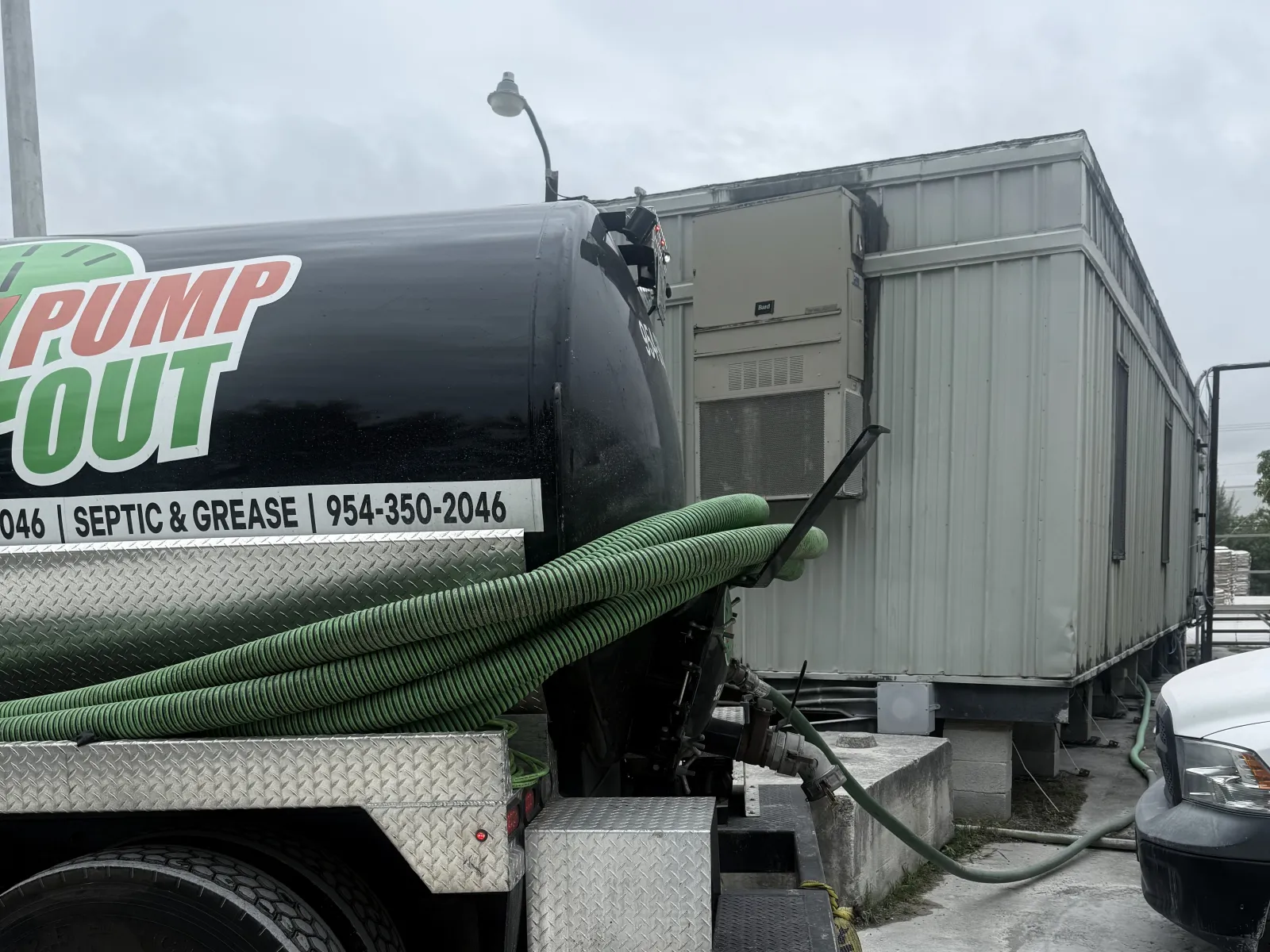
The fix is cleaning the line. Our septic tank pumping takes out all the sludge and scum, and we check the tank’s condition every time. When the lines need jetting too, we pump the tank down, then jet the lines while the system is empty. See the signs of a full septic tank to tell a full tank from a clogged line.
What does commercial hydro jetting cost?
Bob Vila’s January 2024 guide says a residential sewer line can cost $1,000 to clean. A commercial line can reach $3,000. Kitchen lines carry grease. Miami-Dade County says grease hardens when cooled and forms globs that stick to the walls inside sewer pipes.
Miami-Dade calls kitchen grease FOG, for fats, oils and grease. A food business there that can discharge FOG to the public sewer needs a FOG Discharge Control operating permit. The permit is renewed every year and cannot be transferred. It also covers food businesses on a septic system inside a wellfield protection area.
Under the county’s FOG Control Program, operating permits set the cleaning schedule. The standard is every 30 days for hydromechanical interceptors and every 60 days for gravity ones. FOG waste from jetting or rodding must be collected and hauled by a DERM-permitted liquid waste transporter.
Florida’s grease waste law, s. 403.0741, adds paperwork. A hauler must document each removal on a service manifest that records the trap’s condition. The kitchen and the hauler each keep a signed copy onsite for 1 year. A hauler can be fined up to $250 for each failure to clean a grease trap or interceptor.
Our grease trap cleaning pumps, scrapes and washes the trap, on a schedule or on call. If the lines behind it are slow too, we pump the trap, then jet those lines in one visit. We work 24/7, so jetting grease-choked kitchen lines can happen after the kitchen closes.
When is hydro jetting the wrong buy?
Hydro jetting is the wrong buy when the pipe is broken or the drain field is saturated. Water at a pressure matched to the line will not heal a broken or collapsed pipe. A drain field in high groundwater can back up like a clogged line, and no jetting fixes a saturated field.
Pipe age matters too. HomeGuide says pipes over 40 years old may not be suitable candidates for hydro jetting. Modern PVC and cast iron handle it well, while older clay or Orangeburg pipe is more vulnerable. Angi warns that jetting can damage old or weakened pipes, so a professional should check first.
Some plumbers add a camera inspection to the job. HomeGuide, July 2025, prices one at $125 to $750, and Angi, July 2026, at $275 to $1,800. A broken sewer line means repair or replacement, which Angi prices at $60 to $250 per linear foot. For the tank side, see what septic tank repair costs in Florida.
Where does a Florida permit come in?
Florida law bars repairing a septic system without a permit. Rule 62-6.015 says repairs to a failing system need prior written approval. Rule 62-6.002 says pumping a tank, where the drain field is not disturbed, is not a repair. The permit question starts when a failed part gets replaced.
Whether a job counts as a repair is the county health department’s call. Our guide to Florida septic rules and permits for Broward and Palm Beach covers who issues them and when.
How do South Florida roots and groundwater change the job?
Roots and groundwater both shape a South Florida jetting job. UF/IFAS says weeping fig roots are documented to crack pipes and sprinkler lines, buckle pavement, invade pools and clog toilets. Miami-Dade County says groundwater sits just a few feet beneath the surface. It is closest at the end of the wet season, around September and October.
UF/IFAS says the weeping fig, Ficus benjamina, is reported to cause structural damage where planted heavily in urban areas. The native strangler fig, Ficus aurea, is a massive tree with surface roots of its own.
The water table matters most at the drain field. In September and October, a slow system may point to a wet field rather than a clogged pipe. A sludge-packed outlet line reads a lot like a failing drain field, and clearing it shows which one you have.
What changes the number on your line?
The clog and the access set where a job lands. Each item below comes from the cost guides, and each one moves the total.
- How clogged the line is, since Angi says the more clogged it is, the longer the job takes
- Roots, hardened grease or mineral buildup, which HomeGuide says need more intensive cleaning
- Root removal on top of the jetting, at $100 to $600 in Angi’s July 2026 guide
- Access, since HomeGuide says costs are lowest for homes with a cleanout
- Line length: HomeGuide says most homes have 50 to 150 feet of sewer line, and longer lines take longer
- Hours on site: Angi lists $45 to $200 an hour, and Fixr says most clogs take 1 to 2 hours
- Timing, since Angi says an emergency call raises the price
Get a real number for your line
Pricing a line takes a look at it, and quotes are free. Tell us what the drains are doing and when the tank was last pumped. When lines are down, we respond 24/7. Call (954) 350-2046 or use the quote form, across Broward, Palm Beach and Miami-Dade.