How much does grease trap cleaning cost in Florida?
Grease Trap Florida’s 2026 guide puts grease trap cleaning in Florida at $200 to $500 for a standard pump-out. For South Florida it lists $200 to $350 for an indoor trap and $350 to $650 for an in-ground interceptor. PumpLocal, May 2026, prices large outdoor traps of 500 to 2,500 gallons at $300 to $1,500.
Those are market ranges, and a real number needs a look at your trap. The quote is free. Our grease trap cleaning for restaurants and commercial kitchens covers under-sink traps and in-ground interceptors, scheduled or on call.
What does a grease trap cleaning cost per visit?
The device and its size set the grease trap pumping cost. Grease Trap Florida, 2026, prices a 20 to 40 gallon under-sink trap at $150 to $250. A 750 to 1,500 gallon in-ground interceptor runs $400 to $600. Septic Tank Hub, 2026, puts large in-ground interceptors at $500 to $2,000 or more.
| What you are paying for | Typical range per visit | Source |
|---|---|---|
| Indoor under-sink trap, 20 to 40 gallons | $150 to $250 | Grease Trap Florida, 2026 |
| Indoor trap pump-out, South Florida | $200 to $350 | Grease Trap Florida, 2026 |
| Small indoor interceptor, 20 to 50 gallons | $150 to $400 | PumpLocal, May 2026 |
| In-ground interceptor, 750 to 1,500 gallons | $400 to $600 | Grease Trap Florida, 2026 |
| In-ground interceptor pump-out, South Florida | $350 to $650 | Grease Trap Florida, 2026 |
| Large outdoor trap, 500 to 2,500 gallons | $300 to $1,500 | PumpLocal, May 2026 |
| Large in-ground interceptor | $500 to $2,000 or more | Septic Tank Hub, 2026 |
| One 1,000-gallon trap, three bids on one contract | $190, $250 and $550 | Tarrant County, Texas, RFB 2023-033 |
Treat every row as a market range. On Tarrant County, Texas, bid RFB 2023-033, three companies priced the same 1,000-gallon trap at $190, $250 and $550. Those were county sites on an annual contract, not restaurant quotes.
What does a year of grease trap cleaning cost?
A year of cleanings is the per-visit price times the visits your schedule requires. A trap cleaned every 30 days needs 12 visits. At Grease Trap Florida’s South Florida indoor range of $200 to $350, that comes to $2,400 to $4,200.
| Schedule | Visits a year | Per visit, South Florida | Yearly total |
|---|---|---|---|
| Indoor trap, every 30 days | 12 | $200 to $350 | $2,400 to $4,200 |
| In-ground interceptor, every 60 days | about 6 | $350 to $650 | about $2,100 to $3,900 |
| In-ground interceptor, every 90 days | about 4 | $350 to $650 | about $1,400 to $2,600 |
The math uses Grease Trap Florida’s 2026 South Florida ranges and Miami-Dade’s schedules. For an interceptor, the yearly grease interceptor cleaning cost depends on the interval your permit sets.
A service contract can bring the per-visit price down. Grease Trap Florida says contracts typically cost 10 to 20 percent less per visit than one-off calls. It puts a South Florida annual contract for an average restaurant at $3,000 to $7,500. Statewide, it lists $2,000 to $10,000 a year.
How often should a grease trap be cleaned in South Florida?
In South Florida, the cleaning schedule depends on the county and the utility. Miami-Dade sets 30 days for hydromechanical interceptors and 60 days for gravity interceptors. Palm Beach County Water Utilities requires at least once a year. In Broward, the local utility serving your kitchen sets the schedule.
Miami-Dade County requires a FOG Discharge Control operating permit for food businesses that can discharge grease to the public sewer. FOG stands for fats, oils and grease. The permit is renewed every year and cannot be transferred.
The county’s FOG Control Program writes the 30-day and 60-day schedules into those operating permits. The county may allow up to 90 days on a complete engineering analysis. An interceptor with a working monitoring device may go up to 180 days if it meets the standards.
Palm Beach County Water Utilities requires cleaning as needed, and never less than once a year. It samples and inspects traps and interceptors every six months.
The utility also adds an annual OGI fee of $300 to the water bill. To clear a surcharge, the trap gets cleaned first. The customer then sends the invoice or cleaning manifest, plus independent lab results.
In Broward, ask the utility that serves your kitchen which interval applies before you set up service. Whatever the county, keep every manifest on file.
Who is allowed to haul grease trap waste in Florida?
Only licensed grease haulers and self-cleaners may remove and transport grease waste in Florida, per FDEP. The rules sit in s. 403.0741, F.S., and Chapter 62-705, F.A.C. A self-cleaner is a kitchen that moves its own grease waste, under 55 gallons.
Haulers already operating had to apply for a state license before June 5, 2026. Licenses expire April 1 each year. Ask any hauler for its current state license.
Every pump-out gets a service manifest under s. 403.0741. The kitchen and the hauler each keep a signed copy onsite for 1 year. A hauler can be fined up to $250 for each failure to clean a trap, under the statute’s hauler penalties.
Miami-Dade adds a local layer. There, interceptors are cleaned by a liquid waste transporter permitted by DERM.
What should a grease trap cleaning include?
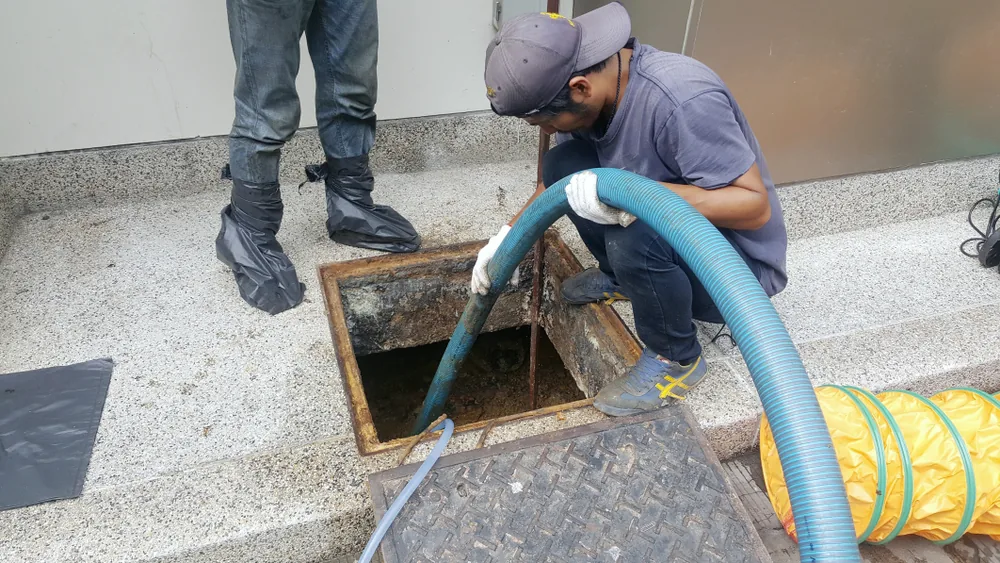
A full cleaning empties the whole trap and cleans its insides. Miami-Dade’s FOG Control Program defines a cleaning as completely evacuating all liquids, solids and FOG. It adds pressure washing or scraping the walls, baffles and pipes. Compare quotes against that standard.
Our scheduled grease trap pumping has the trap pumped, scraped and washed, timed around your kitchen’s hours. Service can happen before prep or after close.
When the line behind the trap runs slow, hydro jetting for grease-choked kitchen lines clears it. Our guide to what hydro jetting costs in Florida covers that price.
A kitchen that drains to a lift station sends it grease every day. There it floats to the top of the wet well and hardens into a cap. Our lift station cleaning pumps out the wet well and washes the floats.
Do restaurants on septic need grease trap cleaning?
Yes, because the septic system sits downstream. Grease that escapes a full trap ends up in the septic tank and then the drain field. In Miami-Dade, the FOG permit also covers food businesses on septic inside a wellfield protection area.
Grease is one of the things that clogs the soil under a drain field. Once the soil around the field seals up, water has nowhere to go but back. At that point the job becomes drain field repair.
Keep the tank on its own schedule too. Our septic tank pumping removes the sludge and scum, and we check the tank’s condition while it is open.
Why does emergency grease trap pumping cost more?
Two charges stack up on an emergency call. Grease Trap Florida, 2026, says emergency response fees of $100 to $300 are standard. After-hours or weekend service adds another premium. In all, it puts emergency service at 50 to 100 percent more than a scheduled visit.
The guide puts an emergency pump-out at $400 to $800 or more. When a trap does back up, we answer 24/7, nights, weekends and holidays included.
What changes the number on your trap?
The trap and the conditions on site set where a visit lands. A bigger trap costs more to pump, and a hard-to-reach lid adds time. Neglect and emergency calls add more. Each item below comes from Grease Trap Florida’s 2026 guide.
- Size: a 2,000-gallon interceptor costs roughly two to three times more per pump-out than a 500-gallon unit
- Neglect: hardened grease means extra pumping time, at $50 to $100
- Baffles: scraping or cleaning them on a neglected trap adds $50 to $150
- Access: a lid under a dumpster pad or a truck parked over it adds $50 to $150 per visit
- Hose run: a truck that can park within 50 feet of the trap means faster service and no access surcharge
- The line behind the trap: hydro jetting the lines runs $200 to $500, as a separate service
- Disposal: some haulers itemize it, at a tipping fee of typically $0.03 to $0.08 per gallon
Get a real number for your trap
Pricing a trap takes a look at it, and quotes are free. Tell us the trap type and when it was last cleaned. You get a real arrival window on the phone. Call (954) 350-2046 or use the quote form, across Broward, Palm Beach and Miami-Dade.