
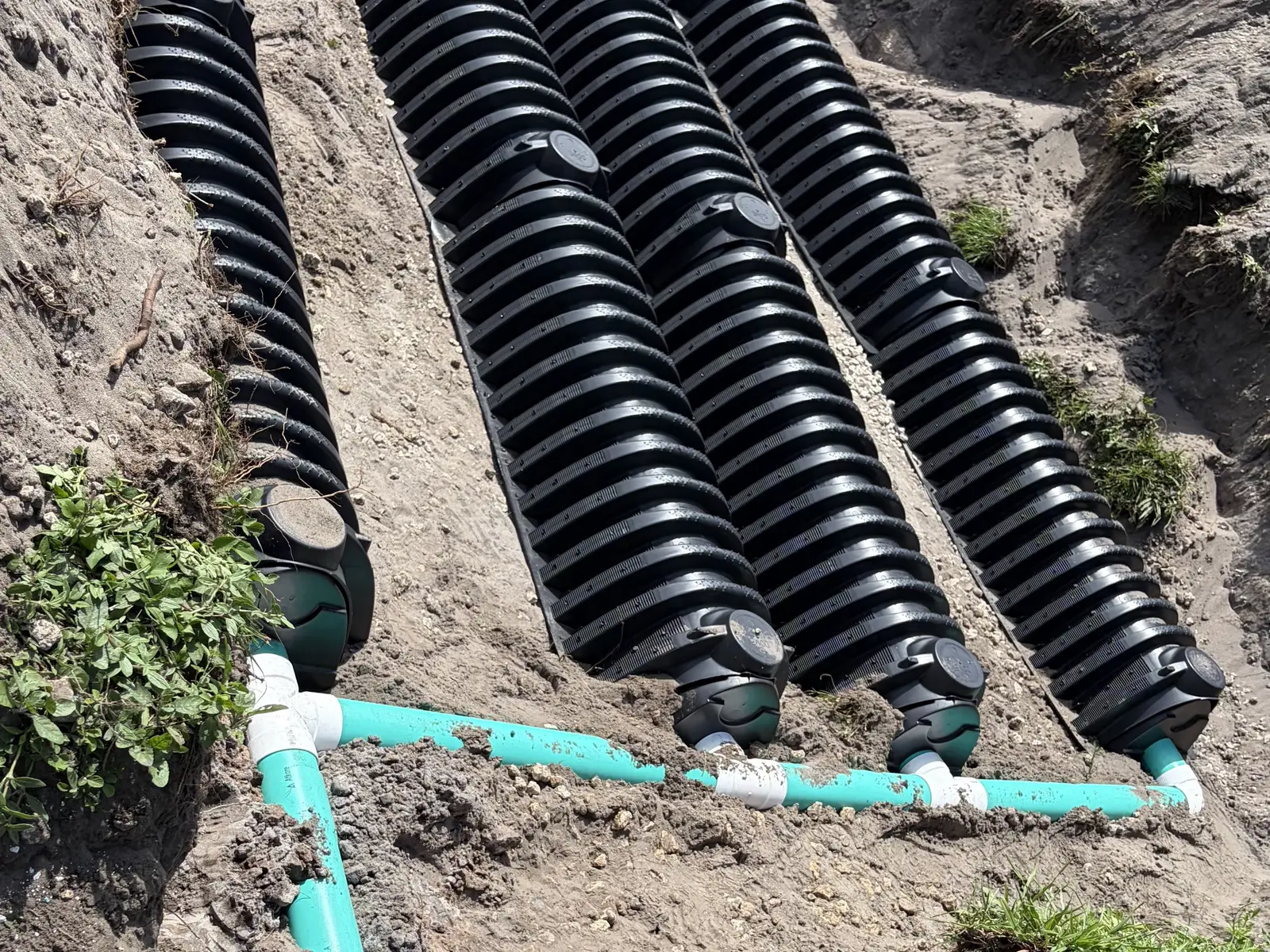
Leach field vs drain field: is there a difference in Florida?
No, a leach field and a drain field are the same part of a septic system. EPA says the liquid leaving the tank goes into perforated pipes buried in a leach field. Its next line says this area is known as the drainfield. UF/IFAS describes a conventional system the same way: a septic tank and a drainfield, or leach field.
Florida’s septic rule picks one of the two words: drainfield. Field soggy or backing up? Our drain field repair service in South Florida takes calls 24 hours a day, 7 days a week. We cover Broward, Palm Beach and Miami-Dade from our base in Pembroke Pines.
Is a leach field the same thing as a drain field?
Yes. Both names point at the same buried area, where liquid from the septic tank soaks into the soil. EPA’s guide to how septic systems work uses both words in back-to-back sentences. It adds a third name too: a typical system is a septic tank and a drainfield, or soil absorption field.
The tank does the first job. Solids settle to the bottom as sludge, and oil and grease float to the top as scum. The liquid in the middle, which EPA calls effluent, flows out to the field. UF/IFAS says most of the cleaning happens in the drain field soil.
So the difference is the word, not the hardware. Leach field shows up in EPA’s own guide. Drain field, or drainfield, is the word in Florida’s septic rule and on Broward’s permit packets.
What does Florida’s septic rule call it?
Florida calls it a drainfield. The state’s septic definitions sit in Rule 62-6.002, last amended July 9, 2025. That rule defines drainfield and mound system but never uses the words leach field. Broward’s health department packets say drainfield too.
The rule’s drainfield is “a system of open-jointed or perforated piping” or other approved units. Those parts spread the tank’s liquid so the soil can filter and absorb it. EPA gives a leach field the same job: slowly releasing the liquid into the soil.
What other names will you hear for a drain field?
You may see absorption field, absorption bed, trenches, chambers, mound or fill. Some of these name the whole field. Others name a part of it, or one way to build it. The table matches each name to what it means and where that meaning comes from.
| Name you may hear | What it means | Source |
|---|---|---|
| Leach field | The buried area where liquid from the tank soaks into the soil | EPA, June 2026; UF/IFAS |
| Drain field or drainfield | The same area; Florida’s rule defines it as perforated piping or other approved units | Florida Rule 62-6.002, July 2025 |
| Soil absorption field | EPA’s other name for the drainfield | EPA, June 2026 |
| Trenches or absorption bed | The field’s layout: a series of trenches or a single bed with perforated pipes | UF/IFAS; Florida Rule 62-6.002 |
| Gravel or stone trench | The older build: liquid piped to a shallow trench of stone or gravel | EPA, May 2026 |
| Chambers | A series of connected chambers, an alternative design to gravel or stone | EPA, May 2026 |
| Standard subsurface drainfield | Florida’s term for a trench or bed with all its sidewalls below the native soil | Florida Rule 62-6.002, July 2025 |
| Filled system | A drainfield with part, but not all, of its sidewalls above the native soil | Florida Rule 62-6.002, July 2025 |
| Mound system | A drainfield built in prepared fill, with any part of its bottom at or above the native soil | Florida Rule 62-6.002, July 2025 |
| Subsurface wastewater infiltration system | The engineering name for a trench or bed drainfield | EPA, May 2026 |
Every name in the table sits on the same side of the system: after the tank, in the soil. A leach field quote and a drain field quote price the same part. Our guide to what a drain field replacement costs in South Florida has the published market ranges.
How does a drain field work in South Florida’s sand and high water?
A drain field needs soil under it that is not full of water. UF/IFAS says Florida permitting puts the field’s bottom at least 24 inches above the wet season high water table. That gap lets the liquid filter through unsaturated soil. Where groundwater sits high, the gap is hard to find.
EPA describes the field as a shallow, covered excavation made in unsaturated soil. UF/IFAS notes special considerations for septic in Florida, because of its unique geography and sandy soils.
EPA lists mound systems as an option in areas with high groundwater. It calls chamber systems well suited to high groundwater tables too. In Florida’s rule, a field with some sidewalls above the native soil is a filled system. Once any part of its bottom sits at or above the native soil, it is a mound.
In Broward, the Florida Department of Health still handles septic permitting and inspection. A repair evaluation there takes two soil profiles in the proposed absorption area. It also records the estimated wet season water table. Our guide to Florida septic rules and permits for Broward and Palm Beach covers the permit side.
What are the signs a leach field is failing?
Backups and wet ground are the big ones. EPA says an overloaded drainfield can flood, sending sewage to the ground surface or backing up into toilets and sinks. Florida’s rule defines failure the same way. Partially treated wastewater reaches the ground, or the house plumbing stops draining properly.
Our drain field page puts soggy or spongy ground over the field at the top of its list. The confirming tell is a tank that refills or backs up again quickly after a pump-out. That means the field is not taking water.
Backups can also start at an overfull tank. Our guide to the signs a septic tank is full covers that side. A septic inspection with a written report checks the tank, lids, baffles, liquid level and drain field.
Can a failing drain field be repaired, or does it need replacing?
Sometimes it can be repaired. FDEP describes alternative repair methods, which repair a failing system without drain field addition or replacement. Florida’s rule also counts replacing a failed field as a repair. Which one fits depends on why the field failed and what the site allows.
Broward’s repair packet says the system must be built by a licensed person. Under the state rule, pumping a tank without disturbing the field is not a repair. We are a licensed septic tank and drain field installation specialist. Our drain field installation service covers replacements for failed fields.
What changes the job:
- The repair route. An alternative repair method works without adding or replacing field. A replacement builds a new one.
- The water table. A high wet season water table can push a new field up into fill or a mound.
- The system’s age. In Broward, a repair field on a system from after 1983 follows the current sizing rules.
- The field size. On a new Broward system, the site plan shows the field at a minimum of 300 square feet. The soil loading rate sets the actual size.
Find out what your field needs
Tell us the city, when the tank was last pumped and what you see over the field. We give a real arrival window on the phone, and the quote is free. Need leach field repair in Broward, Palm Beach or Miami-Dade? Call (954) 350-2046 any hour, or use the quote form.